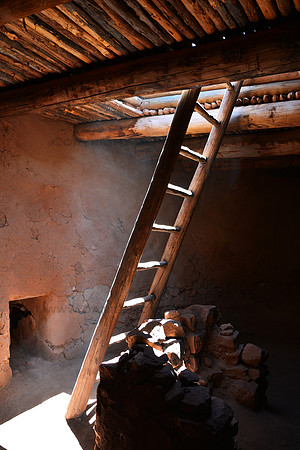
The interior of a restored kiva, a ceremonial chamber, with an access ladder.
"Imagine the house: Poles to support the thatch and mud roof are fitted into four holes near the pit wall. In the center is the fire pit immediately below an opening in the roof that is both the smoke hole and the sole entrance. Nearby is a sipapu, a small hole in the floor that symbolizes the opening in the ceiling of the Third World through which the people emerged into the present Fourth World, according to Hopi legend. There is a ventilation shaft at one side, separated from the fire by a stone fire screen, but it is almost unbearably smoky inside—a very good reason to spend as much time as possible outside. Soot has accumulated on the walls and ceiling, heat has dried the sticks and thatch....and then a spark flies up from the central fire. Some family members escape, some do not." - A. Brockway's Ancient Southwest, Report #2
Located at the Pecos National Historical Park. The name Pecos comes from the Spaniards. The original name was Cicuye Village, a quadrangular pueblo inhabited by more than 2000 people. The pueblo contained numerous ceremonial chambers, called "kivas", and was built around a central plaza on a rocky ridge.
A Coronado chronicler described Cicuye as "a strong village, four stories high. The houses do not have doors below, but instead ladders are used which can be lifted up like a drawbridge."
- DesertUSA
Resources:
Pecos National Historical Park on DesertUSA -
Interpretive tour of Pecos NHP via rap music on nps.gov -
Spanish Encounters on nps.gov -
Pecos National Historical Park on Wikipedia -
Sipapu on Wikipedia -
Anasazi Kivas on abrock.com