
- Home
- | Galleries ▼
- | Collections ▼
- | About ▼
- | Blog
- | Zines
- | Login
Home»Blog
Welcome to my blog! Read about photography, film photography in 35mm, medium, and large formats, pinhole photography, about darkroom printing, alternative photographic processes, and more. Thank you for visiting!
Indoor Projects - Lighting
 Indoor Projects - Lighting
 When the winter gets too long, when excuses not to head out run plenty, when ... well, whatever the reason, it may be a good idea to work on an indoors project and practice different techniques. I like to explore the things that it's better to have answers for in the field. That may be playing with depth of field, testing out hyper focal distance theory vs. practical results, comparing mirror lock up or not, or playing with lighting.
That was the case here with the home-grown crystal formation. Transparent in nature, I wanted to make it glow. I passed on the usual suspect of backlighting and chose to light it from down below and from the front. I placed the crystal formation on a double sheet of black paper with a hole just smaller than the crystal to insure no light leaks around. The paper sheets and the formation were on a sheet of glass from a picture frame bridging two chairs. The gap between the chairs was about three inches, matching the hole in paper and the diameter of the crystal formation. And down on the floor was one Nikon SB-600 speed light (aka flash). That took care of making the crystal formation glow. To complete the set up, I added another flash from about 70 degrees front left.
Have fun!
Polarizer Is Not Just for Blue Skies!
More often than not, you read about using polarizers to darken the blue sky and make white clouds stand out in a dramatic fashion. Many times too much. But another great feature of the polarizer is cutting down reflections. Under the right angle, you can see through reflective window panes, through water, and many other surfaces. This may also help saturate colors of otherwise reflective surfaces. Instead of glare, you can capture the true color of the surface.
 Polarizer Is Not Just for Blue Skies!
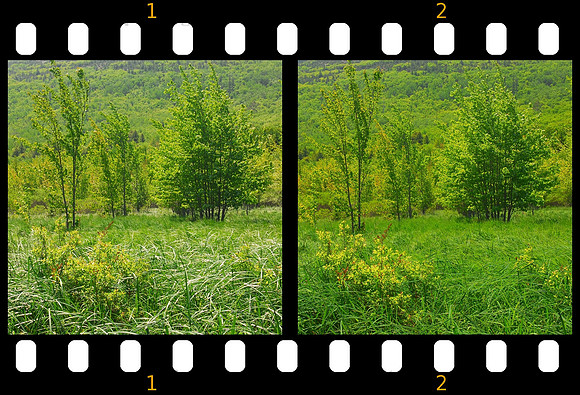
As you can see in this picture on the left, taken with a lens without a polarizing filter, the grass in the bottom picked up strong reflections from sun and is throwing the glare at the camera. Sometimes, this may simply result in weaker color in that particular photo section. Other times, it may result in an overall contrast reduction due to glare if the reflections are really strong.
Now compare to this image on the right. The reflections are gone and the color is back. If this happens to you in a colorful fall foliage scene you can imagine how you could go from low contrast colorless landscape full of glare to a beautifully colorful scene.
Now how about this all green scene? You pick which one you like better.The point here is that not always do you want to remove reflections. For example when photographing animals swimming on a lake, you may actually want to keep the reflections there to separate them from the water that might otherwise swallow them. To the last point you can actually try to use the polarizer again, but for the opposite effect. Rotate it until you see the strongest reflection. If you have the time and a patient subject, try taking several pictures with different rotation of the polarizer and review them later on a larger screen.
Have Fun!
Lacking Perspective
 Lacking Perspective
When there is nothing in a photo to give sense of scale, it is interesting to hear people guess what is in front of them. Many times, macro shots can be mistaken for landscapes, or vice versa. Sometimes, the difference is not that drastic but still, a few-foot mound can be taken as a mountain, or the other way around. I enjoy being challenged like that by the photos of others. Yet, it is difficult for me to guess which of my photos fall into the category and which ones are actually really easy to recognize without the additional clues suggesting scale.
So as you look at this, what lies in front of you? ... Is this an aerial photo of a gigantic volcano eruption (think 100s to 1000s of feet)? Is this a small spewing thermal spring (think 10s of feet)? Is it a blowhole on an ocean coast (under 10 feet)? Or is it a blowhole on a lake shore? Or is it something else, possibly way smaller?
...
Spoiler Alert!
...
This is a Lake Erie Blowhole. It is still in action with the lake having all open water. On windy days, like the one depicted here, the waves push into the ice and snow formations on the shore and shoot out through the volcano further building it up when it is freezing or reducing it when it is warm. The dirty water comes from a lot of sand being mixed in. While not apparent here, the beach is actually free of snow for the most part and the blowing wind filled the air with sand like it was a sandstorm in a desert. I did not last long seeing my camera accumulate water and sand.
In my Buffalo & Western New York Gallery, you can see how these volcanoes look once the lake freezes over and they become dormant.
Have fun!
Change of Pace
 Change of Pace
I like spending time in the middle of nowhere, far from civilization, or at least as far as I can get, and photograph natural landscapes. I like to chase light, be it a sunrise, sunset, or a breaking cloud allowing the sun to briefly peek through. Once in a while, I like to change things around though, get out of my comfort zone, and head in the opposite direction towards the city. And even within the city, in my case most often Buffalo, NY, there are places that most would call beautiful - great architecture, lights, street scenes, and more. Or, you can head in the direction most don't, or at least not with a camera.
Changing the pace, getting out of the comfort zone, serves as a great opportunity not only to capture different subjects but also to do it differently.
For landscapes, I usually like saturated colors. When I shoot portraiture, I usually back off on saturation or even go for black and white. Instead of small apertures, I reach for shallow depth of field in portraits.
For landscapes, I don't try much HDR and prefer either waiting for the right light or the good old and tried split neutral density filters. However, as here, industrial photos is an area where I like the feel HDR gives them!
And in many cases, skills and experience acquired in one area actually lead to great opportunities in another.
This photo shows the Ohio Street Bridge in Buffalo, NY.
Have Fun!
Study in Lighting - Texture
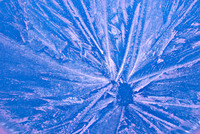 Here's another play with light, this time all reflected, just from different sides and angles. While it may not be obvious from the photo, the camera / lens was not straight over the crystal at a 90 degree angle, but rather something closer to 60 degrees.
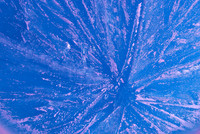 For the top photo, the light was coming from the opposite side at about 45 degrees. For the second photo, it was coming from the side, which in theory should highlight the texture well but judge for yourself. And finally in the last version, the light was straight down from above the crystal.
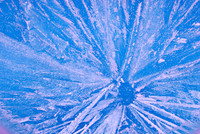 Pretty big difference between each by just changing the direction of the light, don't you think?
The subject is a crystal flower born from dissolved and then crystalized Sodium Acetate.
Have fun!