
- Home
- | Galleries ▼
- | Collections ▼
- | About ▼
- | Blog
- | Zines
- | Login
Home»Blog
Welcome to my blog! Read about photography, film photography in 35mm, medium, and large formats, pinhole photography, about darkroom printing, alternative photographic processes, and more. Thank you for visiting!
Photo Contest Judging (DigitalPhotoPro - Second Annual Photo of the Year Competition)
 DigitalPhotoPro - Second Annual Photo of the Year Competition
 Really? What am I missing here??? Take a look at the 27 finalists and let me know what you think. I'm sorry but these are the 27 best images of the year 2011? Please tell me they have a bug in the system and the finalists gallery is not showing the right stuff. I know this is very subjective but ... I see tons of better photos on Flickr every day! And even their full submission gallery has some great photos in my opinion. But some of the finalists, ... really? I even tried a different browser just to make sure Safari was not breaking up on their script or something like that. Wow!
Study in Lighting - Lighting for Translucent Subjects
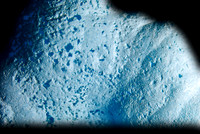 Crystal - Front Lit
These are three identical photos of a crystal where the only variable is lighting, and even that with very basic changes. Since the crystal was translucent I alternated front side-ilighting (top), backlighting, and a combination.
In the side-lit (about 60 degree front side light) version (top) the texture of the crystal surface stands out clearly, however, little or nothing suggests this was a translucent subject.
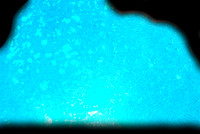 Crystal - Back Lit
In the second version I used backlighting only. The internal structure of the crystal came to life but the front surface rendered completely flat.
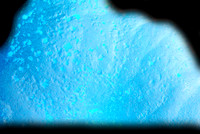 Crystal - Front & Back Lit
In the final version, I combined the two lights thus revealing the translucent nature of the subject while also maintaining some of the texture of the front surface. Of course, many more versions can be had by tuning the ratio between the side and back lights to achieve the desired effect.
The crystal itself was born from dissolved and then crystalized Sodium Acetate.
Have fun!
The Not So Perfect Automatic Flash Exposure
 The Not So Perfect Automatic Flash Exposure
A few posts back, I talked about some situations when automatic exposure will not properly work. Here, I would like to go over a very similar topic and add flash into the mix. Over time, I will be adding more posts around that, however, here I'd like to address specifically the challenges surrounding the balance between the background, or the ambient light, and the photographed subject.
(A) What you can see in the first of the 6 exposures (top left, labeled A in red) is a fully automatic exposure using a Nikon D200 with an off camera SB-600 flash unit controlled using the commander mode on the camera. While this post does directly relate to my experience with the Nikon camera system, I would not be surprised if other brands worked in a very similar fashion. If you see differences with your set up, I'd appreciate to hear back. The camera was in the Program mode, exposure compensation at 0 EV, and flash exposure compensation was also at 0 EV.
As you can see, the owl was properly exposed by the flash, however, the background behind the window was completely blown out.
(B, C) In these two versions, you can see the effect of changing the exposure compensation to - 4 EV and + 4 EV respectively. I picked these significant shifts to make it obvious what is happening, not because either of them would be right. You can see that in B, both the owl and the background are now underexposed while in C they are overexposed.
That is very important! The main, or master exposure compensation, in my case located right by the shutter button along with the mode selector, impacts both your ambient light exposure, the background in this case, and your flash exposure. In fact, if you take the photos using this setting and look into the EXIF data, you will see that the exposure compensation was propagated into the flash exposure compensation despite that showing as 0 in the camera. As a result, this does not let you tame down the background relative to your subject.
(D, E) These two frames show what you can do leaving the main exposure compensation at 0 while adjusting the flash exposure compensation. D is TTL -3 EV, E is TTL + 3 EV. Again, large values are used to make it obvious. As you can see, the ambient, or background light remains constant, and overexposed, while the owl becomes under or overexposed respectively.
(F - bottom left) is what I would recommend doing to stay sane. Switch the camera to manual mode (M) and set your exposure for the background. Set an aperture based on the depth of field you desire while maintaining a reasonable shutter speed up to the flash sync. speed, 1/250 sec. in my case. You can easily use the displayed meter in the camera to set your exposure as desired. In many cases, underexposing the background slightly highlights the subject better. In other cases, you will want to keep it one or two stops over to make it show white without blowing out the highlights. In any case, once you set this, your backgroudn will be exactly what you want it to be, flash or not.
Once you have set the background / ambient exposure, let the TTL flash do the rest. There are reasons why you might want to go to manual flash too and I will get to that later, but I believe this is a great start.
Have fun!
Revisit Your Locations
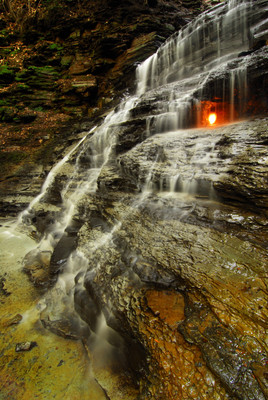 Revisit Your Locations
I really like returning to some of the same locations over and over and over. Why? Every time is different. Seasons change, weather changes, light changes throughout the day. That's the location. However, I change too, get different ideas, find different angles. And sure enough, the resulting photos change too. It's very exciting to compare the photos over time.
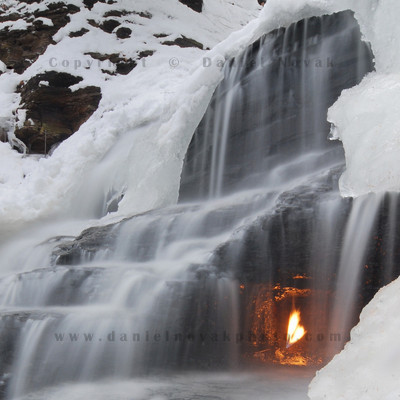 Eternal Flame in Winter
Living close definitely helps make it easier to drop by often. No matter where you live chances are you can find a handful of places to visit repeatedly. How often? Well, up to you. If you have four seasons then at least four times, but you may also want to do a sunrise and a sunset, and based on what it is midday may actually work great too. Live in a cold place? How about with fresh snow? With ice? Is it water, like a waterfall, a river, a creek? You may want to try different strengths of water flow.
This is a photo of the Eternal Flame, one of those wonders of nature. Who'd expect a flame constantly burning in the middle of a waterfall? Chestnut Ridge Park, Orchard Park, New York (NY).
Have fun!
Similar Composition Enough to Violate Copyright?
 Similar Composition Enough to Violate Copyright?
I've just read this article in Pop Photo:
UK Ruling Says Similar Composition Enough Violate Copyright
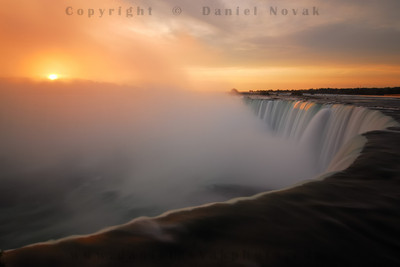
I'm not sure I am reading this right, or the author got it right, or the judge is sane, but I can't imagine this would be for real? How many new unique compositions are there left for the Half Dome, the Watchman, the White House, the Brooklyn Bridge, the Golden Gate Bridge, ...? It sounds like all photographers may soon be criminals and infringers.
Have fun and go shoot it all before someone else does! ;-)