
- Home
- | Galleries ▼
- | Collections ▼
- | About ▼
- | Blog
- | Zines
- | Login
Indoor Projects - Take Notes

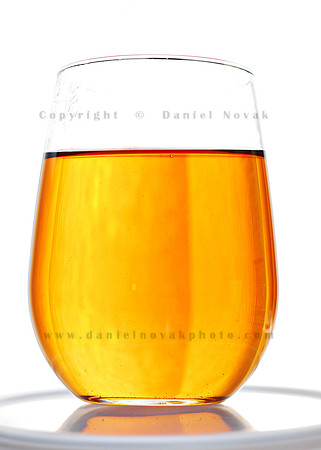
 A while back (about two years), I took the photo of a glass full of tea you see on the left here. It took some serious trial and error to get the lighting just right so that the white area would be completely white and the tea properly exposed. I also got the vertical bands of light and shadow, which I liked since if feels like it adds depth to the photo, making the glass more 3D.
However, the top of the glass was moist from condensation caused by the hot tea and the glass was sitting on a lid on a plastic bowl. I wanted to reshoot this scene and get the glass better prepped up and fully on white without any visible support underneath.
Easy, right? Just remove the bowl, make sure there is no condensation on the glass, set the lights the same way as two years ago, and click away!
Hmm, how did I have the lights set up two years ago? How did I shape the background? How did I make sure there were no errant reflections in the glass that is curved not only horizontally but vertically too, thus picking reflections not only from more than 180 degrees wide but also up from above and below? You think I took notes two years ago? You think I took a photo of my set up back then? No, why, I'd remember.
I did not remember.
After about two hours of fiddling with white and black paper, two external flash units, various supports, and more, I got the second photo in this post.

Let me admit right here, product photos on white background don't seem to fit my black background theme too well. As far as the glass of tea goes though, I achieved what I set to - a uniform white background all around with no visible stand or shadows, all of that straight out of camera with no post-processing, and the top of the glass with no condensation. What I could not repeat though were the vertical bands I really liked in my first photo!
No, I am not giving up and will try again. But this time, once I get it right, I will surely take notes or photograph the set up, which may be the best way to keep the notes along with the photos.
White today's camera's make it really easy to note the exposure and a million other settings, the camera still can't track what it does not know about.
Take notes and have fun!