
Welcome to my blog! Read about photography, film photography in 35mm, medium, and large formats, pinhole photography, about darkroom printing, alternative photographic processes, and more. Thank you for visiting!
Chasing the History
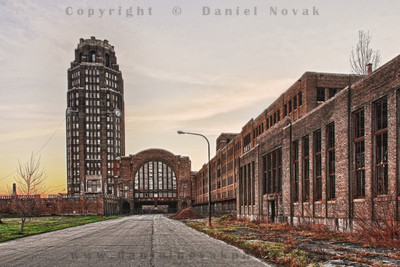

It was one of those mornings that I really wanted to get out early and witness a daybreak. But unlike many other times, I did not head out of the city into the middle of nowhere to be far from civilization. This particular morning I headed towards the city to check out another piece of its history. This particular morning, my destination was the Buffalo Central Terminal.
It was built in 1929 by the New York Central Railroad. It is one of the beautiful Art Deco buildings in Buffalo, NY. Art Deco as a style emerged in 1920s in Paris and spread around the world, enjoying popularity through the 30s and even through World War II. It was a modern style based on geometric shapes and was rather popular for railroad stations in the United States in the 1930s. The terminal closed to passenger traffic in 1979.
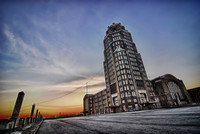 The terminal consists of several different buildings: a 17-story office tower, a main concourse, a baggage building, and a mail building. The terminal changed hands several times: New York Central, Penn Central, Amtrak, Anthony Fedele and Galesi Realty, Thomas Telesco, and finally the Central Terminal Restoration Corporation in 1997. You can find a plethora of information on their web site.
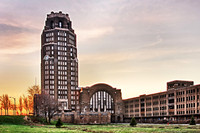 The latest article on their site from March 7, 2012 is talking about the possibility of using the Central Terminal as a satellite to the Albright-Knox Art Gallery, or for other private investments ...
Where's the next sunrise going to take me? No idea yet, but I am sure it will be another amazing show of nature and maybe there will be something manmade there too, or maybe not.
Have fun!
The Great Unexpected
 I had a post on this topic a while back, called Plan but Welcome the Random. I've also already described my experience directly under this photo in my gallery. But I decided I'd also post it here in the blog to highlight what seems to be a repeating experience of mine. Planning is great. Without planning and expectations, chances are I would not be in these gorgeous places. So it is thanks to planning that I make it out during early morning hours and everybody thinks I am crazy. But it actually quite often the random, the unexpected, that gets me the photos that I like the most.
It was a gorgeous foggy morning, just foggy and gorgeous in a completely different way than what I expected. This was not the low hanging fog that fills up valleys and sits over water. This was a thick layer of fog higher up obstructing any clear views into the distance, mostly blocking the horizon, and also keeping the sun away for hours after sunrise. And that was the biggest difference from my expectations. I could see the sun in the east as a faint ball, almost like a full moon, trying to pierce through and bring some light and color into the landscape. That did not happen even two hours into the day, the fog would not burn off.
As a result, sweeping colorful landscapes were not an option, but the fog provided a nice simple backdrop for close ups like this one.
Thank you Mother Nature, this was a morning to remember! Have fun!
Creative White Balance
Most of the time, we try to get the light balance right to interpret what we think we saw. We use various tools to accomplish this, like gray cards, white balance lens caps, white balance filters like the ExpoDisc, Spyder cubes, and others. There are also many ways to correct white balance at post-processing, especially easy if the shot was taken in RAW, and just slightly more challenging if taken in JPG.

This photo to the left was taken well before sunrise looking west and as you can see, the cloud cover was rather heavy in that direction. In this photo, you can see what the photo turned out like with automatic white balance selected. While the automation tried to cut through the blue cast, it was only partially successful.
 The photo to the right is how the same scene would look with no automation, simulated by locking the white balance to sunny. When we get results like this, we either try to use the tools mentioned at the beginning or we counteract by setting the camera white balance to cloudy, or shade in an effort to render a more natural looking scene.
 So here, back on the left is the same photo again, this time with shade setting for the strongest warming effect. As you can see, this did not fully neutralize the scene. The white balance tools would have come really handy but I had none of them with me that morning. So post-processing would have to come to the rescue.
 But as I was looking at the LCD displaying the first photo of this sequence and then looking around, it did not feel right to fight what was in front of me. Instead, I chose to go in the opposite way and select the incandescent white balance on my camera to magnify what the camera observed. In many ways, that was actually what it felt like looking west, especially coma red to the eastward view of wild warm reds, purples, and oranges.
 To finish of, the fifth and final version shows how the scene could look if color balanced in post-production. You make your own choice of what you think works best for you and the next time you're facing a white balance challenge, decide which way you want to go.
Have fun!
PS: Reading Anthropologist on Mars by Oliver Sacks, which is about our minds, how they work, and specifically also about how we perceive color. It does not end with wavelengths, ... but more on that some other day!
Requiem for a Rock
 Sometimes, you're shooting a place that is close to where you live, that feels easily reachable, and the photo either reproducible or even possible to improve upon. But that one time you're there may actually be your only opportunity to shoot the photo in its current form without you even knowing!
This morning, I headed to the Eighteen Mile Creek mouth on Lake Erie and found the location so different than what I remembered from October 2011 when the photo of the rock after sunset was taken.

Last year, the beach on the left of the rock was way short of reaching into this photo, and then on the right there was this nice cove that I enjoyed very much. I don't really have a good photo of it other than the one on the left, but it shows it ok - the tiny strip on the horizon.
This morning, the beach from the left extended way further and would have been between the rock and the horizon all the way through this photo. And the semi circular beach on the right? Gone all together. Maybe it will come back when the water is lower, maybe it will not. We will see. I'm glad I got my rock photo last year.
Time Can Make Quite a Difference!
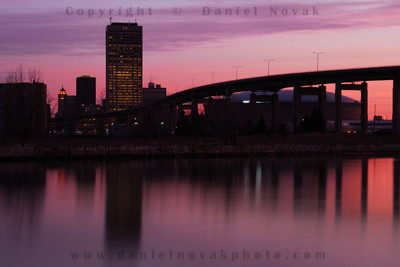 Timing can make a lot of difference in photos. Sometimes, a lot of patience is required, ... hours, repeated visits over several days, weeks, months or years. Other times, it is the opposite and speed matters. You show up, see something really cool but quickly passing and you better be ready to click the shutter. And sometimes, it is a combination. After coming, and waiting, coming, and waiting, coming ... you have to act really quick to take advantage of what nature and luck throw at you.
On this particular morning, as I enjoyed the sun rising and watched the Buffalo skyline beautifully backlit despite being to the north-east, the scene went from what you see on the left to what's on the right within just a few minutes. Yes, the scene got brighter, rather noticeably since I did not adjust my manual exposure, but look at the water!
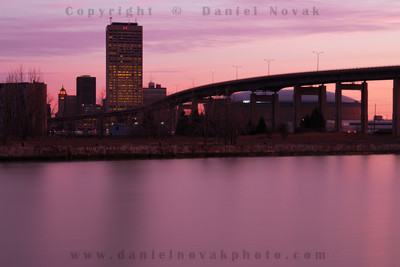 Where did the mirror go? What happened to Lake Erie? Yes, with the daybreak wind broke out too, just a gentle breeze, but enough to turn the water into tiny ripples which completely fogged my mirror in the long exposure.
These two photos were taken 2 minutes apart. Sometimes, the moment can be just a few seconds. Knowing your camera settings by heart and focusing on the creative part is essential. Having charged batteries and space on your memory card as well.
Have fun!