
Welcome to my blog! Read about photography, film photography in 35mm, medium, and large formats, pinhole photography, about darkroom printing, alternative photographic processes, and more. Thank you for visiting!
Worldwide Pinhole Photography Day (WPPD) 2024
 terraPIN ACME3d-printed Pinhole Camera
 As for WPPD 2023 I decided to take out a single camera for the Worldwide Pinhole Photography Day 2024. I really like the results I get out of my 3d-printed terraPIN ACME medium format camera. I made its pinhole by pushing the tip of a tiny needle into a sheet of aluminum harvested from a can of soda (pop for Buffalonians). I did not push it through, just pushed it in enough to create a bump on the other side. Then I sanded that bump off until a tiny hole showed up against the window. If you're interested in the whole background story, feel free to head back to my Custom Made Pinhole for a 3d Printed Pinhole Camera post from 2021.

Steam Locomotive, Worldwide Pinhole Photography Day (WPPD) 2024,
Pinhole photography with terraPIN ACME on Fuji Acros 100 black and white negative film, D-23
Why do I like this camera so much? It's simple, small, lightweight and I get results I like from it. For a handmade pinhole it produces images that are very "sharp" in the center. Yet, it often vignettes quite a bit and not just by light falloff but also by blurring the edges. I am sure there is an explanation for it, but I find it curious. It makes the images look as if I was using an f/2.8 lens and not an f/208 pinhole.
 Steam Locomotive WheelsWPPD 2024
Steam Locomotive Wheels, Worldwide Pinhole Photography Day (WPPD) 2024,
Pinhole photography with terraPIN ACME on Fuji Acros 100 black and white negative film, D-23
The whole week leading into the WPPD 2024 the forecast called for a very nice partially cloudy day. However, I woke up to a completely overcast dark day instead and it was supposed to go from bad to worse, from a drizzle to a downpour. And the progression happened rather quickly. Soon after leaving home, it started coming down rather generously. Instead of going straight to the beach we stopped for lunch as a delay tactics. Good food helped, and the stalling seemed to have worked.

Train Car Suspension, Worldwide Pinhole Photography Day (WPPD) 2024,
Pinhole photography with terraPIN ACME on Fuji Acros 100 black and white negative film, D-23
Still, instead of continuing to the beach I figured we could stop at the train depot that was literally around the corner, just in case the sprinkler kicked in soon. I had photographed the location before but not much and never with a pinhole camera. It was an opportunity for a new take on the location. With the wide angle of the terraPIN ACME and with the dual vignetting of the camera I elected to go mostly for close-up details of the railroad scenery. And the weather had some mercy and it only drizzled.

Driftwood, Worldwide Pinhole Photography Day (WPPD) 2024,
Pinhole photography with terraPIN ACME on Fuji Acros 100 black and white negative film, D-23
As you can see from the last photograph, we did eventually make it to the beach, but it was pouring by that time. I had 4 frames left on the roll of 12 and really wanted to finish the roll to be able to develop it and see and share the results "quickly". After fifteen minutes of so in the car I decided to act and brave the elements. I was sloppy though and lacked excitement and only added one sharable frame, the one above. That leaves an opportunity to go pinholing again when the weather forecast looks good by looking out of the window.
Enjoy The Beauty That Surrounds You! #etbtsy
More of my Pinhole Photography ...
 In and Out of WaterWPPD 2023
 Flooded Jagged GapsWPPD 2023
 Down Smoke CreekWPPD 2023
A Beautiful Morning Faraway
Just watching these old photos now makes me want to be there, stand on the coast full of anticipation, listen to the crashing waves, and have a slice of the paradise for myself. Sunrises reward the early birds almost anywhere. I don't mind at all that most people prefer to sleep in. And you know what, it can be anywhere so these photos might just motivate me to get out early even without being on a vacation. I must admit it's been a while since I experienced and captured a local sunrise.
 Shipwreck Beach SunriseKauai, Hawaii
Shipwreck Beach Sunrise, Kauai, Hawaii
Within just a few steps we go from the peaceful sunrise to a wild action of crashing waves. The force of water always inspires awe whether I watch coastal waves or the rush of the Niagara River. It's also mesmerizing and I could stay and watch for a long time.

Makawehi Waves, Kauai, Hawaii
And to close, we are back for a variation on the opening photograph with just a slight change of the perspective and time passing. How much time? It's about 50 minutes after the sunrise photograph.
 Shipwreck Beach DaybreakKauai, Hawaii
Shipwreck Beach Daybreak, Kauai, Hawaii
Are you ready to set your alarm (for 5am), crawl out of the bed, and go welcome a brand-new day (just after 6am in Buffalo, NY)? I hope so!
Enjoy the beauty that surrounds you! (#etbtsy)
Previously from Hawaii: The Beginning - Seaside Pinhole Photography - Tropical Clichés - Windy Drama of a Tropical Morning - Quite an Ad - Searching for Sun and Warmth - Not Your Sunrise Cliché - So Peaceful - Some Morning Drama - Farmland in the Canyon - Further up Waimea Canyon - At the Edge of Kalalau Valley - Tropical Sunrise - Tropical Sunset - The Photo at Your Back - Hawaiian Mix - A Beautiful Morning Faraway
 Lava Rocks at Waiohai BeachKauai, Hawaii
 Gulf State Park Pier at SunsetAlabama
 The Start of a Beautiful Day at Secret Beach, Kauai, HawaiiKauai, Hawaii
Darkroom: Charles Bridge Nostalgia
In 2023, I was able to spend 2 nostalgia-packed days in Prague, Czech Republic. I arrived by a morning train, took metro to the Holešovice station, and started a very long walk. While Holešovice is not exactly what Prague is known for or where tourists rush to find gems, it was the neighborhood where my university dormitory was located and my home for about four and a half years.
More on that whole experience later though. I am still contemplating how to attack that topic. Today is only about one very brief moment as I made my way to the parts of the city one might see on the Internet and in various travel articles. There, standing on the banks of the Vltava River, I was happy to snap the scene presented below with my trusty Nikon FE loaded with Fomapan 400. It may be silly but all of my black and white photography in the Czech Republic is always on Foma films. It seems like the right thing to do. And the 400 variety with its more pronounced grain seemed to fit the nostalgic nature of my trip rather well.
One thing I did differently on this trip was the whole travel with film. As more and more airports replace the old X-Ray baggage scanners with CT scanners it became more of an issue than in the past, especially if one must pass through several checkpoints before reaching the destination. Therefore, I ordered 10 rolls of film direct from Foma and had them waiting for me at my mom's place, along with the developer, fixer, and all of the hardware one needs to home-develop film. Only one thing traveled with me, which was my 2-roll developing tank, which felt wasteful to buy an extra one. By the end of my 2-week trip I finished and developed all 10 rolls and had them stored in archival sleeves for a travel safe from the CT scanners.
This whole topic has me wondering though about how I will be able to use film on shorter vacations to destinations where I won't have family or friends as a base to ship supplies to ahead of time. Will I be forced back to digital? Will I gamble and rely on the friendliness of the security staff to do a hand check of my film?
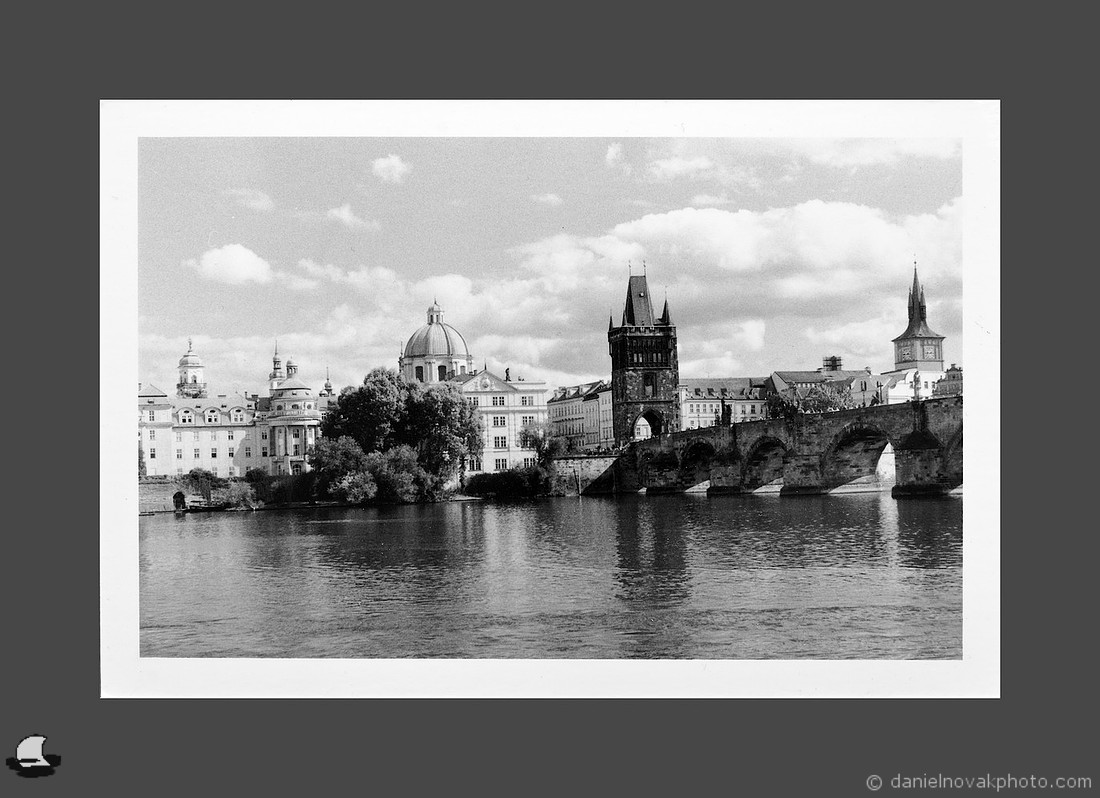 Charles Bridge, PragueDarkroom Print
Charles Bridge, Prague, Czech Republic
Traditional Black and White Darkroom Print on Ilford MG V RC Portfolio
I wanted to make over a dozen of these prints to use as postcards for friends. I started with the Ilford MG IV portfolio paper I still had left over, did all of my tests, and settled on grade 2 contrast filter as the sunny day, even in mid-afternoon, created plenty of contrast in the scene. The orange filter mounted on the lens at the time of capture darkened the blue sky nicely helping the white puffy clouds stand out.
However, when I ran out I had to switch to the new emulsion formula of the Ilford MG V portfolio paper. In the end, for this specific scene, I determined the difference was mostly in the native contrast. After printing the photo with a grade 1 contrast filter and putting it side by side with the results on MG IV I could not see any other difference. Since I like contrasty prints and usually print at grade 3 or higher, this should not pose a problem other than change of habits and probably starting at grade two as my new base. I will see and share as I print more variety with the new paper.
Needless to say, I was and still am very happy with how this print came out and how I can remember my walk with something else in my hand than the screen of a smart phone. How do you like to store photographs from your vacations, your places filled with memories? Do you print, darkroom or inkjet, do you order photo albums, do you rely on a software catalog on your computer, do you upload everything to a cloud provider to store and share, or does social media fill that role for you?
Enjoy The Beauty That Surrounds You! #etbtsy
For more darkroom prints, please, head over to my Darkroom photo gallery.
Previously from the darkroom:
 Roofs & ChimneysDarkroom Print
 ChimneysDarkroom Print
 (New) Castle StairsDarkroom Print
Pinhole Panoramas from Buffalo's Outer Harbor
Most of my pinhole photography is in black and white. However, I do enjoy seeing other photographers' pinhole photography in color and that challenges me to try it myself once in a while. On this specific outing to Buffalo's Outer Harbor I loaded up the Holga Wide Pinhole Camera (WPC) with Lomography 100 color negative film and tried to take advantage of the panoramic format to capture a favorite location differently.
The camera can be adjusted to capture either 6x9cm or 6x12cm images. Since 6x9 would turn it into the same 2x3 aspect ratio as 35mm film I always use it in its full 6x12 mode.
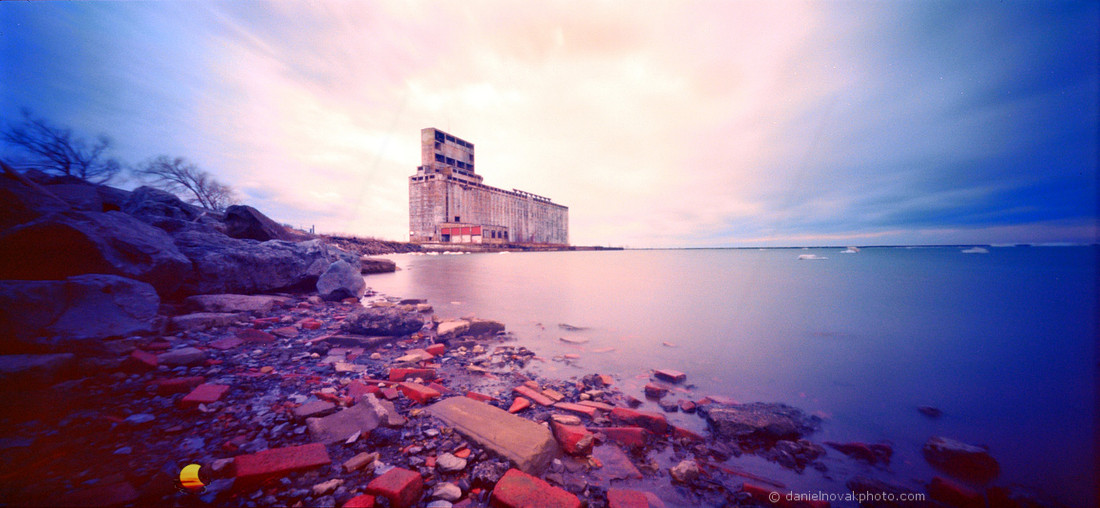 Gallagher Beach & Cargill Pool Grain ElevatorPinhole Photography
Gallagher Beach & Cargill Pool Grain Elevator,
Pinhole photography with Holga Wide Pinhole WPC on Lomography 100 color negative film, C-41
I usually scan my medium format (120) film using an Epson flatbed scanner. However, for these two photos, I went the route of "scanning" the frames with my digital camera. Color negative film poses a special challenge as most of them have an orange mask. That does not seem to effectively use the RGB image sensor plus inversion and color correction is tricky. Yes, there are some apps available for this purpose but since I do not capture the "scans" on my phone the workflow seems unintuitive to me.
Thus, I wanted to try something closer to what one would do printing color in the darkroom. In that case, the enlarger features color sliders for cyan, magenta, and yellow to allow for color correction. In my case, I bought several Rosco color correction gel filters (4415, 3204 1/2 CTB, 3202 CTB), laid those on my white backlight, overlaid the color negative over those, and photographed with a digital camera. The goal was to counteract the orange mask with the gels and later simply invert the negative image into a positive without the use of any specialized software.
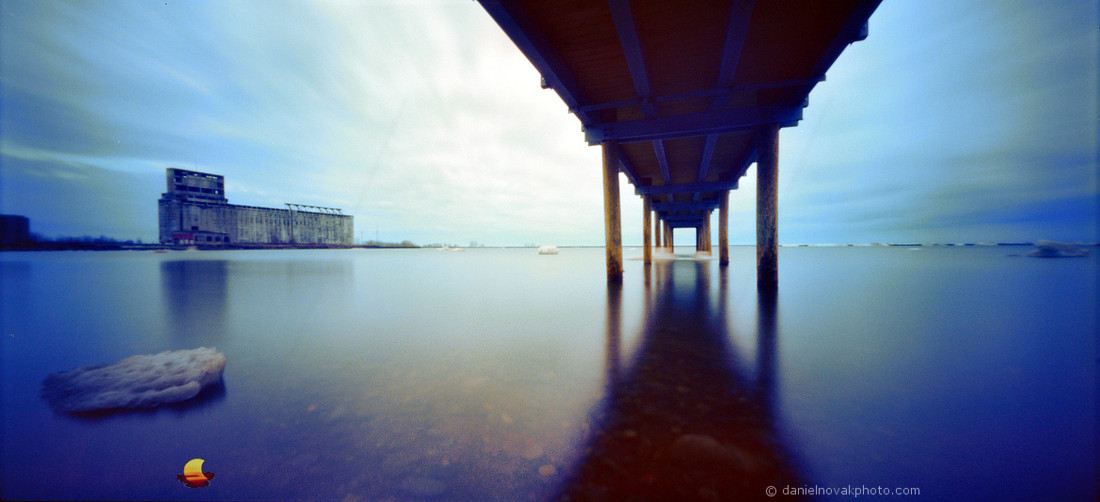 Gallagher Pier & Cargill Pool Grain ElevatorPinhole Photography
Gallagher Pier & Cargill Pool Grain Elevator
Pinhole photography with Holga Wide Pinhole WPC on Lomography 100 color negative film, C-41
The result? The concept worked and getting an initial usable positive image was rather straightforward. However, accomplishing an accurate color correction was a whole different story. In the end, I was getting photos as if special color effects were applied and instead of trying to correct them out, I leaned into them. You see two sample results above. I have not used this technique since and I suspect today's post will motivate me to try again.
Introducing unpredictable and hard to repeat steps into a workflow can either be very frustrating, or very rewarding depending on ones expectations. And in my photography, I am growing more and more fond of the concepts behind lomography. In fact, I may have to lean into this even more. Who is to say that the various sheets of color gel have to fully overlap? Why not arrange them into stripes of different color, or triangles of different color, or just plain color chaos? But more on that another day.
Enjoy The Beauty That Surrounds You! #etbtsy
More of my Pinhole Photography ...
 Rocky Banks of Niagara RiverPinhole Photography in Color
 The Kill ZonePinhole Photography in Color
 Water Zooming ByPinhole Photography in Color
Cyanotypes XIV: Gulf Shores, Alabama
You've got a glimpse into last year's vacation in Gulf Shores, Alabama in the ongoing Alabama 2023 series of posts (last one being Alabama 2023, Part V, Magnolia Springs). Today, I offer a little different view of that trip. I'm sharing two pairs of photographs for comparison. The first photo of each is a straight cyanotype on a textured watercolor paper and the second is a bleached version toned in wine tannin for a different vintage look.
 Paradise Isle Resort OfficeCyanotype
Paradise Isle Resort Office, Gulf Shores, Alabama, An Original Hand-Made 5" x 7" Cyanotype
Chemically Printed on a Hand-Coated Textured Shizen Design Watercolor Paper
The first pair is of a really eye-catching oceanfront resort in Gulf Shores with its office front and center. I really enjoyed capturing photographs of the resort in many different ways, whether it was digitally or on film, in color or in black and white. And I like how the cyanotype process combined with the rough texture of the paper rendered the scene too.
 Paradise Isle Resort OfficeToned Cyanotype
Paradise Isle Resort Office, Gulf Shores, Alabama, An Original Hand-Made 5" x 7" Cyanotype
Chemically Printed on a Hand-Coated Textured Shizen Design Watercolor Paper, Toned in Wine Tannin
Next up is an interior scene from Fort Morgan. Wagon wheels have their charm and automatically invoke days gone by. Capturing them with an old film camera seems appropriate. Making a cyanotype print of one was rather satisfying too and the fact that it was located in an old fort did not hurt. It's also another application where I believe the very rough texture of this specific watercolor paper helped the outcome.
 Fort Morgan Wagon WheelCyanotype
Fort Morgan Wagon Wheel, Gulf Shores, Alabama, An Original Hand-Made 5" x 7" Cyanotype
Chemically Printed on a Hand-Coated Textured Shizen Design Watercolor Paper
As with the first pair, let's compare the blue version to a copy toned in wine tannin. Toning adds a good dose of processing. I leave the primary cyanotype prints out to dry for at least 24 hours during which oxygen does its thing. I am not sure whether or how much that really matters as I have not experimented with prompter bleaching. I only bleach the prints after 24+ hours and at the moment I prefer bleaching them fully with almost no image left. That takes several minutes. Once bleached I fully wash the paper to get all of the washing soda out.
Then comes the toning. I usually start with a warm bath and have the tray on a heating pad to keep the liquid above room temperature. It helps speed things along a bit. Too much warmth might cause overall paper staining so you'll have to experiment as each paper responds differently. Toning can take anywhere from a few minutes to about an hour. I do not leave prints in the toning bath longer. Afterwards, one more thorough wash, drying, and flattening under a stack of books.
 Fort Morgan Wagon WheelToned Cyanotype
Fort Morgan Wagon Wheel Toned Cyanotype, Gulf Shores, Alabama, An Original Hand-Made 5" x 7" Cyanotype
Chemically Printed on a Hand-Coated Textured Shizen Design Watercolor Paper, Toned in Wine Tannin
Which versions do you like more? The classic blue cyanotypes or the toned ones that resemble the traditional black and white look?
Thanks for visiting, hope you'll be back :-)
Enjoy The Beauty That Surrounds You! #etbtsy
Previous posts in the Cyanotypes series: 1. First Cyanotype - 2. More Cyanotypes - 3. Highlands Cyanotypes - 4. How do Cyanotypes Happen? - 5. Cyanotypes V: Tweaking the Curve - 6. Cyanotypes VI: Toning - 7. Cyanotypes VII: More Toning - 8. Cyanotypes VIII: Toning Different Papers - 9. Cyanotypes IX: Horní Rozsíčky - 10. Cyanotypes X: From Black and White or Color - 11. Cyanotypes XI: Moravian Countryside - 12. Cyanotypes XII: Prague Castle - 13. Cyanotypes XIII: American History - 14. Cyanotypes XIV: Gulf Shores, Alabama
If you like cyanotypes, you can explore the Cyanotypes Photo Gallery dedicated to my growing collection of them. Would you like to browse through traditional darkroom wet prints? Visit my Darkroom Photo Gallery and enjoy!
 Smith's Fort CyanotypeCyanotype
 Fence at New Town, Jamestown, CyanotypeCyanotype
 John Brown's Fort CyanotypeCyanotype
 Smith's Fort, Toned CyanotypeToned Cyanotype
 Fence at New Town, Jamestown, Toned CyanotypeToned Cyanotype